The three routes, priced
Every "how much does scrollytelling cost" answer hides the same fork: who does the work. Here are the three routes with the numbers we could verify on October 17, 2026.
| Agency | Freelancer | DIY platform (ours) | |
|---|---|---|---|
| Typical price | Clutch's October 2026 web design guide: average reviewed project $38,105, most projects under $10,000. Scrollytelling specifically, from a studio that publishes its ranges (Metabole, April 2026): €8,000 to €15,000 for a scroll section in an existing site, €25,000 to €60,000 for a full immersive page, €60,000 to €200,000+ for a full production | $25 to $49 an hour for builder-based work (Clutch); senior developers $100 to $160 an hour in North America, $80 to $130 in Western Europe, a single landing page $2,000 to $8,000 (freelancedesk, April 2026). Marketplace listings run from a $300 Fiverr gig to a $20,000 Upwork catalogue offer for a ten-page scroll site | $0 free plan (one AI story), $9 once for a single story, $10 to $49 a month for plans with custom domains, downloads and several live stories |
| Time to a live page | Weeks to months; Clutch's typical project length is 7 months | Days to weeks | 3 to 5 minutes to generate; 57% of published stories went live within an hour of creation (last 90 days) |
| Revisions | Two or three rounds in the contract, then change orders at the hourly rate | Negotiated per job, often capped | Unlimited, free, done by you in a visual editor |
| Who edits it in month seven | The agency, unless you contracted otherwise | The freelancer, if still available | You, in the browser |
| Ownership | Whatever the contract says; US default is not "work for hire" without a written clause | Same | Yours; paid plans download the story as a self-contained .zip |
| Design ceiling | Unlimited: art direction, 3D, WebGL, custom motion | High, within the freelancer's stack | High within the platform's elements; no custom shaders or 3D |
Sources, all read October 17, 2026: Clutch web design pricing guide (updated September 21, 2026); Metabole Studio on scrollytelling pricing and immersive website cost (April 2026); Freelancedesk freelance rates 2026 (April 2026); Fiverr and Upwork listings as shown in search results that day (not verified purchases); platform prices from our pricing page; build times from our production data for the 90 days to October 16, 2026 (190 published stories).
What drives the price, in order
The same five things push an agency quote, a freelancer quote and your own time budget. If you control them, you control the bill.
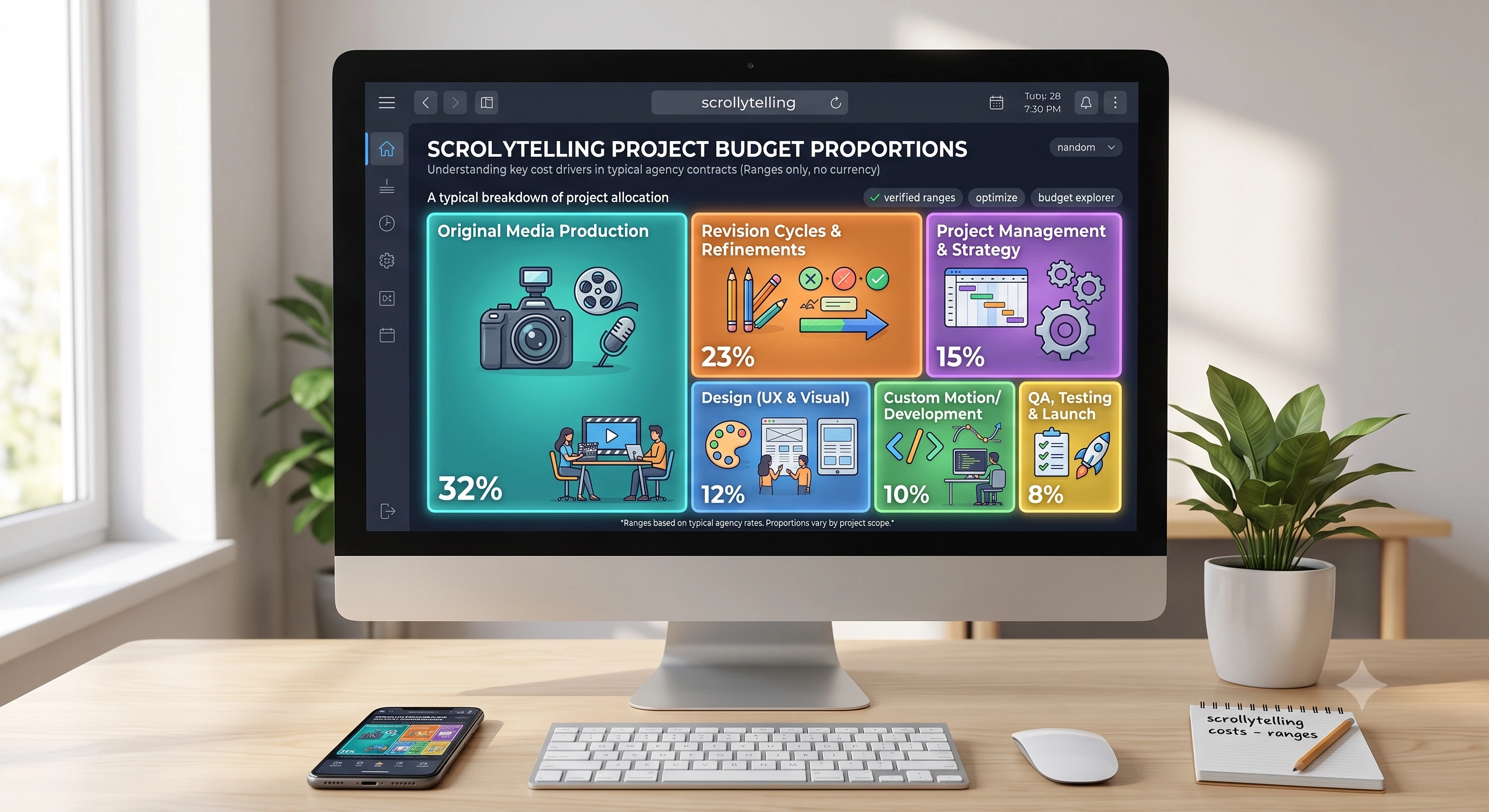
- Original media. A photo or video shoot is a production with crew, day rates and post. Routinely the largest line in an agency quote, and the one a DIY platform replaces with generated or existing imagery.
- Custom motion and 3D. Scroll-linked 3D scenes, shaders, a globe you can spin. Specialist hours, impossible to estimate honestly up front, and the one thing no template-based tool, ours included, will give you.
- Content readiness. If copy and data are not final at kickoff you pay someone to wait and then to rework. On a platform the equivalent cost is your own afternoon.
- Sign-off complexity. Every additional approver adds a revision round. Agencies price it; platforms let you absorb it for free.
- Languages and accessibility. Real work on any route, and routinely discovered late when they were not in the brief.
Agency: what $10,000 to $100,000 buys
Nobody will quote you a scrollytelling page without a scope, so the honest benchmark is the general web design market. Clutch, which collects verified reviews with budgets attached, reports for October 2026 an average project of $38,105, a typical length of 7 months, shortlisted agency rates of $100 to $149 an hour, and that most reviewed projects still come in under $10,000. Read those together: a few large engagements pull the average up, and bespoke scrollytelling belongs in that tail because it carries the expensive ingredients, original photography or film, custom motion, and more revision rounds than a brochure site.
One studio that does publish its own ranges, Metabole in Paris and Rotterdam, quoted in April 2026: €8,000 to €15,000 for a dedicated scrollytelling section integrated into an existing site, €25,000 to €60,000 for a demanding full-page project, €60,000 to €200,000 and above for a full production with original media, and €80 to €150 an hour for a senior WebGL developer, with maintenance at €200 to €800 a month afterwards. Those numbers sit exactly where the Clutch distribution says bespoke work sits.
What the money buys is a six-stage engagement: scoping, discovery and narrative, art direction, build, QA, revisions. Only two of those produce something you can look at. Our guide to scrollytelling agencies walks through each stage, the handover questions to ask in the first call, and the change-in-month-seven problem that decides whether the piece stays alive after launch.
One practical tactic that lowers risk more than it lowers price: ask for the quote in phases with a stop point after discovery, so you can walk away with the narrative outline if the build numbers do not work.
Freelancer: the middle route
A single developer or designer-developer building the page with GSAP, Scrollama or native CSS scroll-driven animations. Clutch puts builder-based freelance work at $25 to $49 an hour; Freelancedesk's 2026 survey puts senior developers at $100 to $160 an hour in North America and $80 to $130 in Western Europe, and a single landing page at $2,000 to $8,000. A hand-coded scroll page with pinned sections and a scrubbed video sequence is a multi-day job even for someone who does it weekly, so expect a quote in the low thousands for one page and more once original video, illustration or a data visualisation is involved. The marketplaces show the spread: a $300 Fiverr gig promising a scrollytelling site in five days at one end, a $20,000 Upwork catalogue offer for a ten-page scroll site at the other; what you get for $300 is a template.
You save on overhead and you lose the parts an agency bundles: nobody is writing the narrative, running QA across devices, or guaranteeing availability when a figure changes next quarter. If you go this route, put the editing surface in the brief: ask for the page to be built on a platform or CMS you can change yourself, not as a one-off bundle of files.
DIY platform: $0 to $49 a month, and where the credits go
This is the column we sell, so here is exactly what it costs. The free plan builds one AI-generated story with a hero video and six images and publishes it on a subdomain at $0, no card. A single story without any subscription is $9 once. Plans are $12, $29 and $59 a month, or $10, $24 and $49 billed yearly, and the differences are the number of live stories (3, 10, unlimited), the monthly AI credits (250, 1,000, 3,000), a custom domain, the badge removed, and downloads as a self-contained .zip or HD PDF on every paid plan.
How credits turn into a page: an AI-generated story spends roughly 48 to 72 credits (the hero video is 20, each image 4), so the free plan's 60 monthly credits cover one new story and a few regenerated images, and Starter's 250 cover three or four. Editing by hand, text, colours, layout, spacing, never costs credits; only generating new media does. Most of the people who publish never spend beyond their plan.
Three things are worth knowing before you compare it to the quotes above. Generation takes three to five minutes. You paste a URL or upload a PDF and the page is built from your own photos and text, not stock. And it is a hosted product: the page lives on our infrastructure, with a custom domain on paid plans, WordPress and Shopify embeds, or the downloaded .zip hosted wherever you like.
What you give up with DIY
Be clear-eyed, because the gap is real. A platform converges on a house style by design; you are choosing from scroll effects, templates and widgets that exist, not inventing a motion language for your brand. There is no WebGL, no custom shader, no 3D scene, no illustrator on call. The narrative is yours to write or to accept from the AI, and nobody is interviewing your sources or cleaning your dataset. If the brief says "it must look like nothing else on the internet", that is an agency sentence, and the hire-or-build guide says so plainly.
For the other cases, the product story that tracks a product, the annual report that gets a restated figure, the campaign page you need by Friday, the fourth story of the month, the ceiling rarely matters and the month-seven editing does.
Time is the other cost
The number people underestimate on every route is the calendar. Clutch's typical project runs seven months. A freelancer build is days to weeks plus the waiting between messages. On the platform, our production data for the last 90 days shows 57% of published stories going live within an hour of being created and 78% within a day; the median story is one afternoon, including the edits. That difference is why the hybrid most teams land on is "commission the flagship, standardise the rest": one agency piece a year, everything downstream built in-house.
Don't want to build it yourself?
If you would rather hand over a brief, we build the first page for you from your material and you take it from there in the editor. There is no public price for this because it depends on the material; write to gintaras@scrollytelling.ai with a link to what you have and what the page is for, and you will get an answer from the founder, not a form.
Frequently asked questions
How much does a scrollytelling page cost?
It depends on who builds it. An agency project sits in the general web-design range Clutch reports for October 2026: an average of $38,105 per reviewed project, with most projects under $10,000 and rates of $100 to $149 an hour; bespoke scrollytelling with original media and custom motion lands at the upper end. A freelancer is cheaper per hour but you manage the project. A DIY platform costs $0 to $49 a month and the first page exists in minutes.
How much does a scrollytelling agency charge?
Studios that publish ranges put a scroll section in an existing site at €8,000 to €15,000 and a full immersive page at €25,000 to €60,000 (Metabole, April 2026). The general benchmark from Clutch (September 2026) is $100 to $149 an hour, an average project of $38,105 and a typical length of 7 months. Ask for the quote in phases with a stop point after discovery.
What does a scrollytelling freelancer cost?
Builder-based work is $25 to $49 an hour on Clutch; senior developers $80 to $160 an hour depending on region, and a single landing page $2,000 to $8,000 (Freelancedesk, 2026). A hand-coded scroll page takes days, so budget in the low thousands for one page; marketplace listings range from $300 template gigs to $20,000 catalogue offers.
How much does scrollytelling cost on a platform like Scrollytelling.ai?
The free plan builds and publishes one AI-generated story at $0. A single story without a subscription is $9. Plans with custom domains, downloads and several live stories are $12, $29 and $59 a month, or $10, $24 and $49 billed yearly. Editing by hand is free; only new AI media uses credits.
How long does a scrollytelling page take to build?
On the platform, generation takes 3 to 5 minutes and, across the last 90 days, 57% of published stories went live within an hour of being created and 78% within a day. Agency projects run weeks to months because discovery, design, build and QA are separate phases with sign-off between them.
When is it worth paying an agency?
When the piece needs bespoke art direction, original reporting or data work, WebGL or 3D, or when it is the centrepiece of a campaign with a real media budget behind it. Our agencies guide covers how to run that engagement.
See what the $0 route produces
Build one story on the free plan. If it is good enough, you have your answer for a fraction of any quote above; if it is not, you have a much sharper brief.
Create your story → Read the agency guide →