When hiring an agency is genuinely the right call
Start here, because the rest of the page only makes sense once this is settled. Five situations where a good studio earns its fee outright, and no tool closes the gap.
Bespoke art direction. If the piece must look like nothing else on the internet — illustration commissioned for this story, a motion language invented for this brand — you are buying taste, and taste is not a feature. Template-based systems, ours included, converge on a house style by design. That is the point of them and also their ceiling.
Original data journalism or reporting. Someone has to clean the dataset, interview the sources, check the claims and decide what the story is. That labour dwarfs the build. If your project starts with a spreadsheet nobody has interrogated, the interrogation is the project, and it is a human service.
WebGL, 3D and custom simulation. Scroll-linked 3D scenes, shader work, a globe you can spin. Specialist engineering: a generalist tool will not produce it, and a generalist developer takes three times as long as someone who does it weekly.
A one-off flagship with a real media budget. If you are spending six figures on distribution, the landing experience should not be the cheapest line item.
No internal capacity. The most common reason, and a perfectly good one. If your team is two marketers and a part-time designer, the fastest route to a finished thing may be paying people whose whole job this is. Tools do not create time.
If two or more of those describe your project, hire. Use the rest of this page to evaluate the quotes.
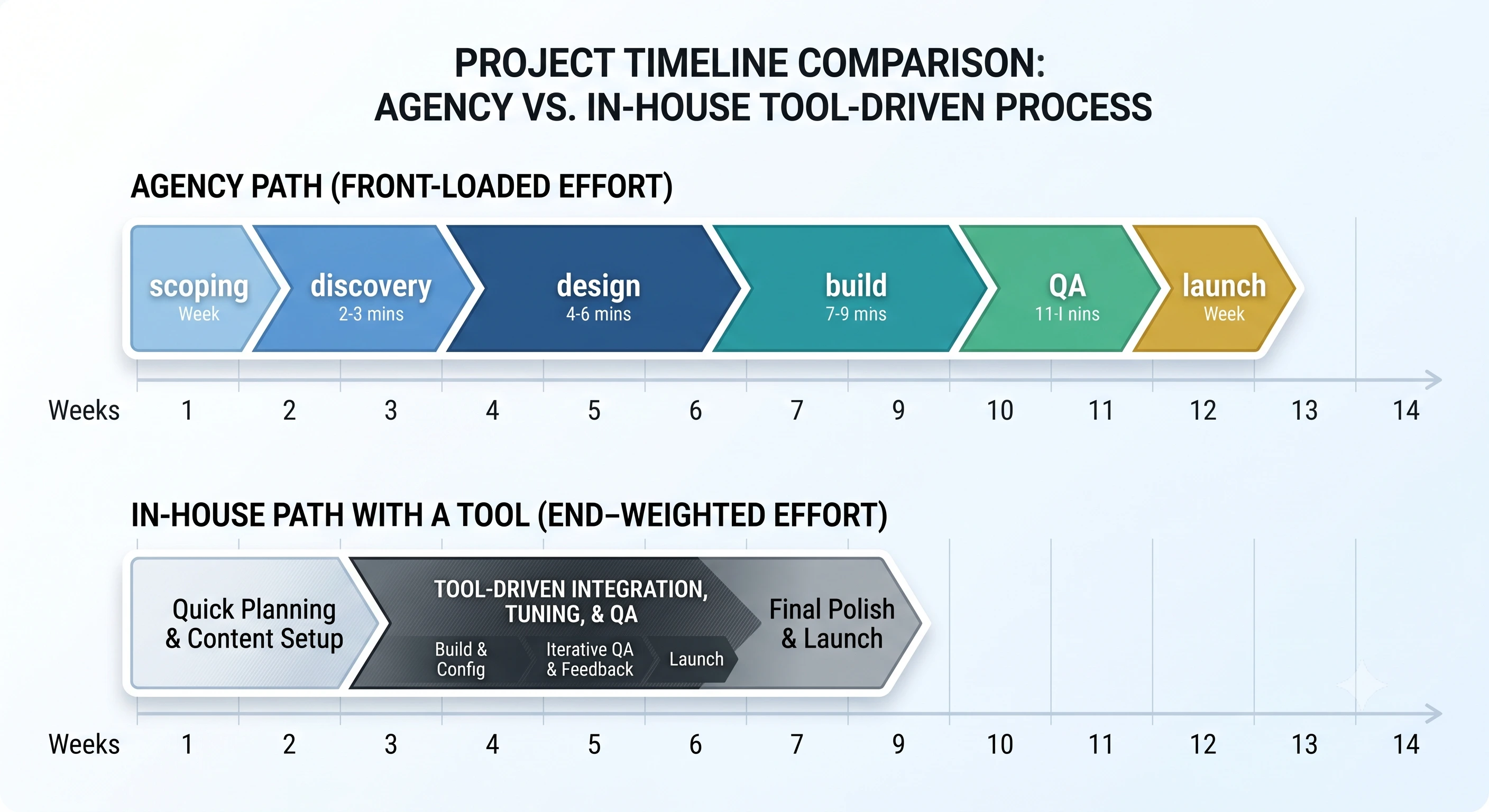
What an engagement actually involves
Most first-time buyers underestimate how much of an agency project is neither design nor code. A project runs through six stages, and only two produce anything you can look at.
1. Scoping and proposal
Before anyone quotes, a studio needs to know how many sections, how much media, whether the content exists, whether there is a data pipeline, how many languages, and who signs off. Read the assumptions section of the proposal more carefully than the price — assumptions are where a fixed price quietly becomes variable.
2. Discovery and narrative
Someone decides what the story is: the spine, the sequence, what the reader knows at each point. Good studios treat this as a distinct paid phase with its own deliverable — a narrative outline or wireframed scroll script — because approving the story before the visuals is far cheaper than approving it after. If a proposal jumps from kickoff straight to design comps, ask why.
3. Art direction and design
Static comps of key moments, a motion study for the transitions, a design system for the repeating parts. Motion is hard to approve from stills, which is why better studios prototype one scroll sequence interactively before designing the rest. Ask for that.
4. Build
Typically hand-written HTML, CSS and JavaScript, often with a scroll library doing the observation work. Scrollama, the MIT-licensed library maintained by Russell Samora, is a common choice in newsrooms and relies on IntersectionObserver rather than scroll events. Some of the same effects can now be done in pure CSS via scroll-driven animations, which run off a scroll progress or view progress timeline instead of a clock. Ask which approach a studio uses and what the fallback is, since support is not universal yet.
5. QA
The stage that gets compressed when the schedule slips, and the one that decides whether the piece works on a four-year-old Android phone on a train. Ask what the test matrix is: which devices, which browsers, what network throttling, and whether they test with reduced motion enabled.
6. Revision rounds
Contracts almost always name a number, commonly two or three. Anything beyond that is a change order at the hourly rate — reasonable, and also the mechanism by which a fixed-price project stops being fixed-price. Batch feedback and consolidate stakeholders before each round rather than during it.
The deliverable, hosting, and who can edit it
Ask these four questions in the first call, not the last:
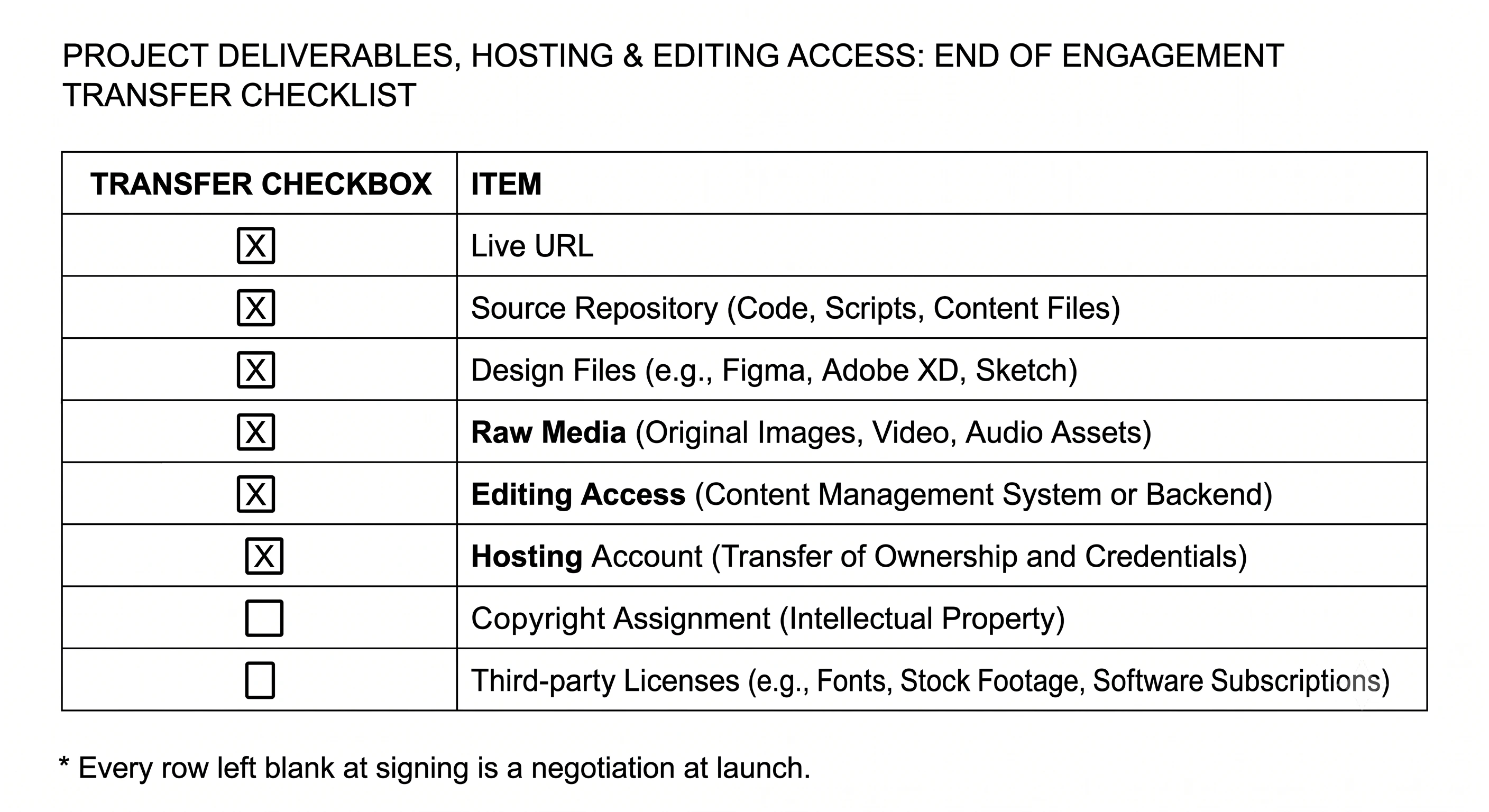
- What exactly do we receive? A live URL only, or the source repository, the design files, the raw media, and the export pipeline for any rendered frames?
- Who hosts it? Many studios host flagship pieces on their own infrastructure. Convenient in month one, a dependency in month eighteen. Find out what year-two hosting costs and what happens if you stop paying it.
- What is the editing surface? A bespoke build often has none. If someone needs to change a number or swap a photo, ask for a live demonstration of a non-developer doing exactly that, during the pitch, on the real system.
- Who owns the copyright? Under 17 U.S.C. § 101, work by an independent contractor is only a "work made for hire" if it falls into one of the enumerated categories and both parties sign a written agreement saying so. Absent an explicit assignment, the US default is not what most buyers assume. Reputable agencies handle this with a standard assignment clause; ask to see it, and ask separately about font, stock and library licences, which are frequently licensed to the agency rather than transferred to you. (General information, not legal advice.)
The change you need six months later
This is the honest strongest argument for using a tool, and it has nothing to do with launch day. It is about month seven.
A commissioned piece is usually a custom bundle: a hand-built page with a bespoke scroll timeline, tuned offsets, image sequences rendered at specific dimensions. It works beautifully. It also has no admin panel. So when legal asks you to soften a sentence, or a figure gets restated, or the person in the team photo leaves, the change does not go to whoever noticed it. It goes into an email to the studio, joins their queue, and comes back as a small invoice.
None of that is bad faith. It is the arithmetic of custom software, and it compounds:
- Latency. A one-word fix takes days, not minutes, because it needs someone else's calendar.
- Minimums. Many studios bill small changes against a minimum block, so a typo costs the same as an hour.
- Bus factor. The developer who wrote the scroll timeline moves on; the next one quotes discovery before touching it.
- Drift. Dependencies age and browsers change, so a page nobody has opened in a year needs unbudgeted maintenance.
Pages built this way tend to be published once and then frozen. Fine for journalism, quietly expensive for anything commercial — a report, a case study, a product story that has to track a product. If your content will change after launch, price the changes into the decision, not just the build.
The fix, if you go the agency route, is contractual: agree a support retainer or a per-change rate up front, and insist that whatever content is genuinely volatile lives somewhere your team can edit. Do not accept "we'll sort that out later." Later is when it costs the most.
What it costs — in ranges you can verify
We will not invent a price list. What we can do is point at a large public dataset of real agency engagements. Clutch's web design pricing guide, checked August 2026, reports an average reviewed project cost of $38,105.39, a typical project length of 7 months, and typical agency rates of $100–$149 per hour — while noting that most reviewed projects still come in under $10,000.
Those two numbers point in opposite directions, and that is the useful part. A typical project under $10,000 alongside a mean near $38,000 means a small number of large engagements are pulling the average up. Bespoke scrollytelling belongs in that tail, because the things that push a web project past average — original photography, commissioned illustration, custom motion, 3D, a data pipeline, localisation — are precisely what a scrollytelling brief asks for.
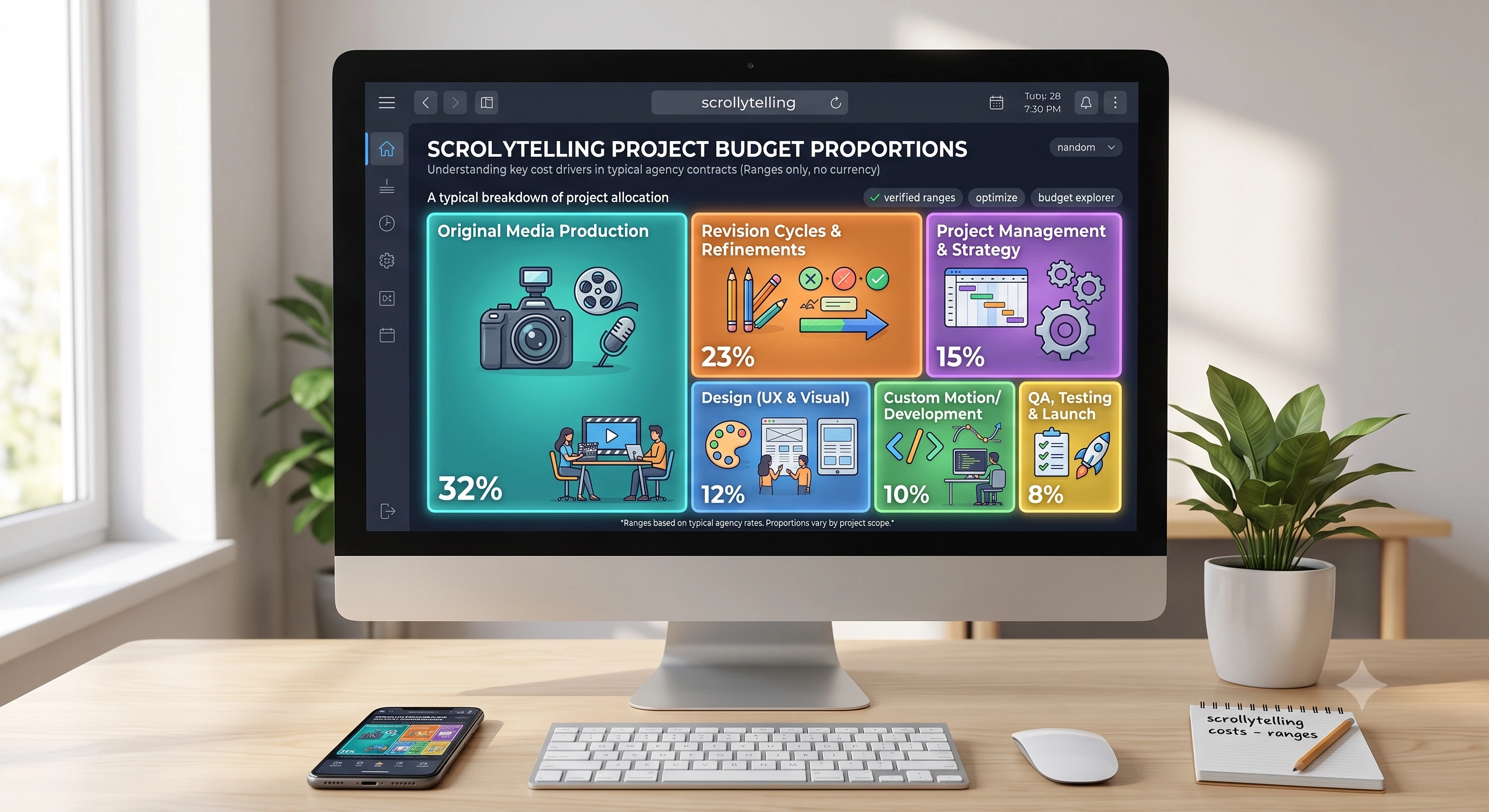
What drives your number, roughly in order of impact:
- Original media. A shoot is a production, with crew, day rates and post. Routinely the largest line.
- Custom motion and 3D. Specialist hours, and the hardest thing to estimate honestly up front.
- Content readiness. If copy and data are not final at kickoff, you pay the studio to wait, then to rework.
- Sign-off complexity. Every additional approver adds a revision round somewhere.
- Languages and accessibility. Real work, both routinely discovered late if they are not in the brief.
One practical tactic: ask for the quote broken into phases with a stop point after discovery. A studio confident in its process will price discovery separately and let you walk away with the narrative outline if the numbers do not work. One that insists on an all-or-nothing fixed price before knowing your content is guessing, and the guess will be padded.
Directories like Clutch let you filter studios by minimum project size before you spend a call finding out you are below it.
How to choose an agency if that is the right route
We deliberately do not publish a ranked list of agencies. We cannot verify other companies' client work, rates or capacity, and a list we cannot verify is worth nothing to you. The evaluation method is more durable anyway, because studios change.
Judge the portfolio by opening it, not reading about it
Case-study pages are art-directed to flatter. Ask for live URLs of shipped work and open them yourself, on your phone, on a normal connection, ideally on a mid-range Android rather than the newest iPhone. If several portfolio links are dead, that tells you who maintains what after launch. Our gallery of examples and the roundup of famous scrollytelling examples are useful calibration before you review pitches.
Test performance, not just polish
Scroll experiences are heavy by nature, and the failure mode is jank under the reader's thumb. Interaction to Next Paint is a stable Core Web Vital, and the published threshold for "good" is 200 ms or less at the 75th percentile. Run a studio's live work through a field-data tool, then ask what the heaviest asset on the page is and how it is delivered. A studio that answers in specifics is one that thinks about it.
Ask about motion accessibility explicitly
Two things to raise; the answers are diagnostic. First, prefers-reduced-motion, a CSS media feature available across browsers since January 2020, should already be wired into any motion-heavy build. Second, WCAG 2.2 Success Criterion 2.3.3, Animation from Interactions (Level AAA) requires that motion animation triggered by interaction can be disabled unless it is essential. Scrolling itself is fine — the guidance treats moving new content into the viewport as essential and user-controlled — but decorative parallax layered on top of it needs an off switch.
Check the handover story, not the launch story
Ask past clients one question: what happened when you needed a change in month twelve? That answer predicts more of your experience than the whole portfolio does. Then confirm in writing what the editing surface is, who holds the hosting account, and how the assignment clause is worded.
"Scrollytelling Agentur": the German-speaking market
If you are searching in German, the term is Scrollytelling Agentur, and plenty of searches arrive as Scrollytelling GmbH — the GmbH suffix simply reflects that the limited-liability company is the standard incorporation form in Germany, so buyers type the company designation into the query the way they would for any supplier.
The format has unusually deep roots in the region, and that shapes the market. After the wave of ambitious multimedia features in 2012 and 2013, the innovation team at German public broadcaster WDR built a reusable story engine so smaller newsrooms could produce the same thing without a bespoke build every time. That engine became Pageflow, open-sourced and introduced at re:publica in 2014, developed by Codevise Solutions and hosted in Germany — a detail the product still leads with, which tells you how often German-speaking buyers ask where the data sits. We keep a comparison of Pageflow and Scrollytelling if you are weighing that route.
The upshot: the same three options exist as everywhere else — commission an Agentur, license a platform, or use a browser-based tool — but the platform layer in the region is more mature than the English-language conversation suggests, and hosting location is a normal first-call question rather than an afterthought.
The hybrid most teams land on
In practice the hire-vs-build framing is a false binary. Three routes exist, and they are good at different things:
| Commission an agency | License a platform | Browser-based tool | |
|---|---|---|---|
| Design ceiling | Unlimited — bespoke art direction, 3D, custom motion | High within the platform's system | Good, but converges on a house style |
| Time to a live page | Weeks to months, discovery first | Days to weeks after onboarding | Same day |
| Who edits it later | The agency, unless you contracted otherwise | Your team, in the platform | Your team, in the browser |
| Cost shape | Large one-off, plus change orders | Recurring licence, often annual | Low or usage-based |
| Best for | One flagship piece with a media budget behind it | Teams publishing regularly at enterprise scale | Frequent pieces, changing content, small teams |
The teams who get the most out of all three do some version of this: commission the flagship, standardise the rest.
The agency builds the one piece that has to be extraordinary — the campaign centrepiece, the anniversary story, the WebGL thing. Everything downstream, the pieces that change often, gets produced in-house with a tool: the interactive report, the launch page, the customer story, the recruiting page. The flagship sets the visual language; the tool carries the volume.
A second version is to buy art direction rather than production: commission a studio for narrative structure and design direction only — a scroll script, a type and colour system, a motion reference — and have your own team implement it. You pay for the expensive judgement and skip the expensive hours. It only works if your implementation surface can honour the direction, so check that first.
Either way, build a rough version yourself before you go shopping. Our guide to scrollytelling design patterns covers the structures nearly every piece is assembled from, scroll-driven storytelling covers the technical side, and the tools roundup compares platforms, including the ones that are not ours. If the rough version gets you most of the way there, the brief you write afterwards will be sharper and cheaper.
Frequently asked questions
What does a scrollytelling agency actually deliver?
Usually a live URL and the files behind it: a designed, built and QA'd page, plus whatever source files and editing surface were in scope. What varies enormously is everything around that — who hosts it, whether a non-developer can change a headline, and whether the contract assigns you the copyright. Those questions decide what the piece costs you in year two.
How much does a scrollytelling project cost?
Nobody can quote a real number without a scope. For a benchmark: Clutch's web design pricing guide, checked August 2026, reports an average reviewed project cost of $38,105.39, a typical project length of 7 months, and typical agency rates of $100–$149 per hour, while noting most reviewed projects come in under $10,000. Bespoke scrollytelling sits in the upper tail of that distribution, because original art direction, custom motion and heavy media are what push a web project past the average.
What is a "Scrollytelling Agentur"?
It is the German-language phrase for the same service — "Agentur" means agency, and German-speaking buyers search for "Scrollytelling Agentur" or "Scrollytelling GmbH", GmbH being the standard German limited-company form. The format has deep roots in the region: Pageflow, an open-source multimedia storytelling platform hosted in Germany, came out of broadcaster WDR's innovation team and was introduced at re:publica in 2014.
Who owns the code when an agency builds your scrollytelling piece?
Whatever the contract says, and in the United States the default is less generous than most buyers assume. Under 17 U.S.C. § 101, work by an independent contractor only counts as a "work made for hire" if it falls into one of the enumerated categories and both parties sign a written agreement saying so. That is why competent agency contracts contain an explicit assignment clause. Ask for one, and ask separately about font, stock and library licences. General information, not legal advice.
Can we edit an agency-built scrollytelling page ourselves later?
Only if you specify it up front and test it before signing. A bespoke build is frequently a hand-written bundle of HTML, CSS and JavaScript with no editing interface at all, so every future change is a ticket back to the agency. If in-house editing matters, ask for a live demo of a non-developer changing a headline, swapping an image and publishing — during the pitch, on the real system.
When is a scrollytelling tool better than an agency?
When you need more than one of these a year, when the content changes after launch, when the deadline is shorter than a discovery phase, or when nobody on your team can maintain custom JavaScript. A tool caps how bespoke the result can be and in exchange removes the dependency: the person who wants the change can make it. For a single flagship piece with original reporting and a real media budget, an agency is still the better answer.
Write a better brief — or skip it
Build a working version of your story in the browser first. Either you ship it, or you hand a far sharper brief to the studio you hire.
Create your story → Browse templates →