Pageflow pricing in 2026, and how it compares to an AI-built scroll story at $10 a month
Last updated: October 17, 2026 · Open-source multimedia storytelling tool from German public broadcasting
Pageflow pricing in 2026
Pageflow is refreshingly clear. Its pricing page on October 17, 2026 lists four hosted plans in euros including German VAT, a free unlimited test period with every feature, and the reminder that the software is open source if you would rather host it yourself.
| Pageflow plan | Price | What you get |
|---|---|---|
| Free test | €0 | Unlimited time, all functions, not published |
| Personal | €8.50/month (€7.50 billed yearly) | 1 user, 3 published stories, Pageflow branding, no own domain |
| Standard | €49/month (€45 yearly) | 1 user, unlimited stories, own domain |
| Business | €149/month (€135 yearly) | 5 users |
| Premium | €399/month (€350 yearly) | 20 users, 3 sites, unlimited traffic |
| Self-hosted | €0 licence | Open source; needs Rails operations experience |
Is Pageflow free? Testing is free for as long as you like; publishing starts at €8.50 a month for three stories with Pageflow branding and no custom domain. A custom domain costs €49 a month. USD variants exist at the same numbers. Prices checked on October 17, 2026 on pageflow.io/en/pricing.
Pageflow vs Scrollytelling.ai: what each one is
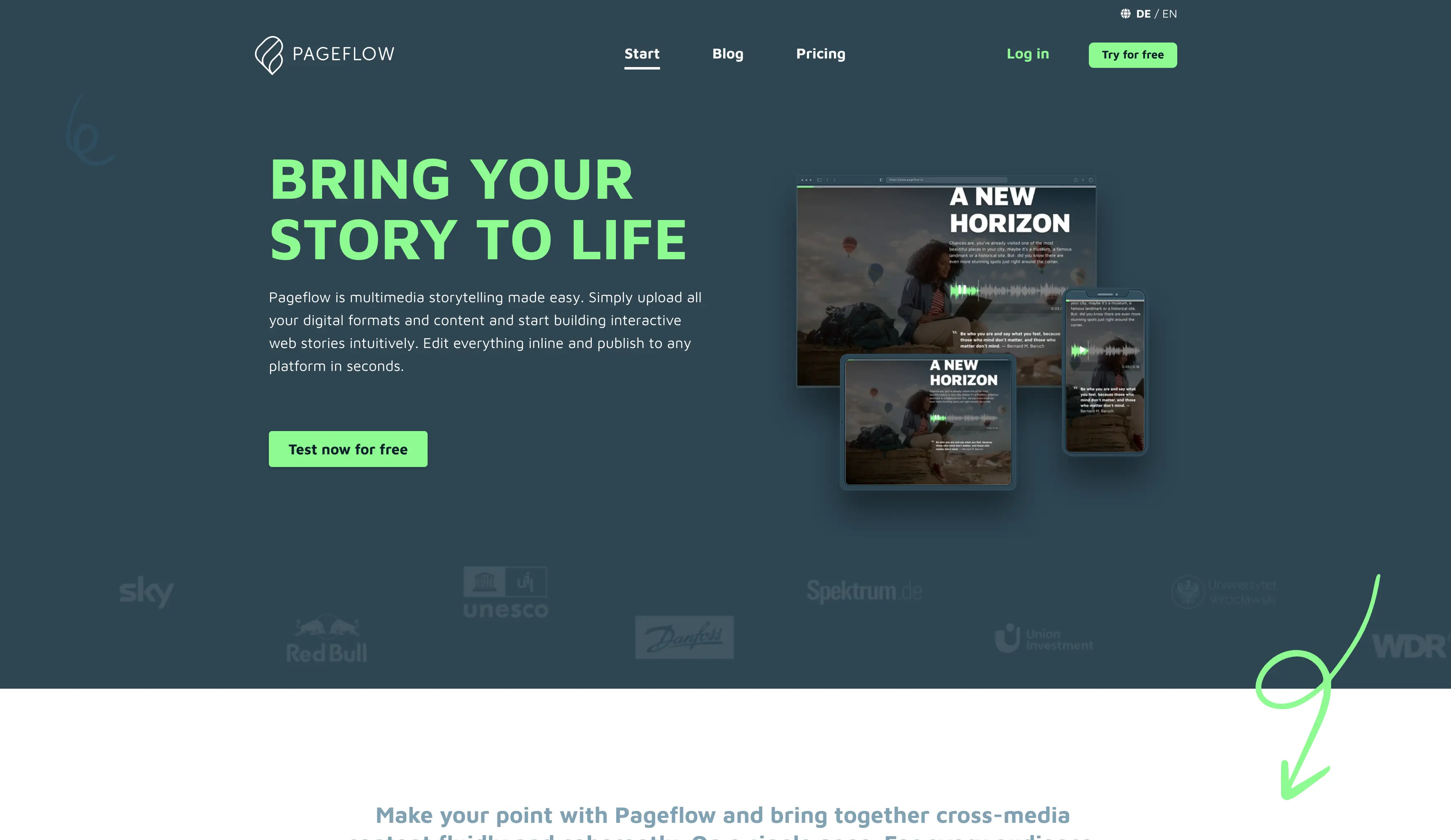
Pageflow grew out of WDR, the German public broadcaster, as an engine for web documentaries: full-screen video and audio, chapters, immersive transitions. It is open source, used by newsrooms across the German-speaking market, and sold as a hosted service with honest pricing.
Scrollytelling.ai is the AI-first alternative: you describe the story or paste a source and the page is generated, hero video included, then edited visually. It is the faster route for marketing pages, reports and product stories; Pageflow is the deeper route for a documentary with hours of footage.
Side by side
| Feature | Scrollytelling.ai | Pageflow |
|---|---|---|
| Price | Free plan; Starter $12/mo ($10 yearly); Pro $29 ($24 yearly); Pro+ $59 ($49 yearly) | Personal €8.50/mo, Standard €49, Business €149, Premium €399 (incl. VAT) |
| Free plan | Yes: 60 monthly credits, 1 published story on a scrollytelling.ai link | Free unlimited testing; publishing from €8.50 |
| Scrollytelling | Core of the product: scroll-scrubbed hero video, stacking cards, split scroll, reveals, scenes | Yes: chapter-based web documentaries with video and audio |
| AI generation | Full story from a prompt, a URL or an uploaded PDF, images and hero video included | No |
| Hosting and domain | Hosted; custom domain on every paid plan; WordPress and Shopify embeds | Hosted; own domain from Standard (€49); open-source self-hosting |
| Editing | Visual editor, free manual edits; AI edits use credits | Manual chapter editor |
| Export | .zip of the story and HD PDF on every plan, Free included | Self-host the open-source version |
| Team | Invite members on Pro and Pro+ | 1 user up to Standard, 5 on Business, 20 on Premium |
What Pageflow does better
Pageflow is better for video-led documentaries: chapter navigation, ambient audio, full-screen video backgrounds and the pacing of a web documentary are its native language. It is better for organisations that want to self-host open-source software, and for German-speaking newsrooms where it has roots and hosting in Germany. Its pricing is transparent, and the free test period is unlimited.
Where Pageflow falls short, and who should look elsewhere
Three stories with branding and no domain for €8.50 is fair but limited; the jump to a custom domain is €49 a month, nearly five times Scrollytelling.ai's Starter. The editor assembles stories by hand, and the interface shows its age against 2026 tools. There is no AI generation of the story itself, no scroll-scrubbed hero video, and the design range outside the documentary format is narrow.
If you are coming from Pageflow
Bring the footage, skip the assembly. Describe the story and upload a clip; the AI structures the page and turns your video into a scroll-driven hero. Chapters become sections.
Custom domain for $10. Starter includes it with 10 published stories and the badge removed, where Pageflow asks €49.
What you lose: self-hosting of open-source software and the documentary-specific audio and chapter tools.
Verdict
Choose Pageflow if you make web documentaries with video and audio at the centre, want open-source software you can self-host, or publish from a German newsroom.
Choose Scrollytelling.ai if you want AI to build the scroll story from a brief, a custom domain from $10 a month, and a format suited to marketing, reports and product pages.
Frequently asked questions
How much does Pageflow cost?
Hosted plans are Personal €8.50, Standard €49, Business €149 and Premium €399 a month including VAT, or €7.50, €45, €135 and €350 billed yearly (checked October 17, 2026). Self-hosting the open-source version is free apart from your own operations.
Is Pageflow free?
Testing is free for unlimited time with all features. Publishing needs a plan from €8.50 a month, which includes Pageflow branding and no custom domain.
What is the cheapest way to get a custom domain: Pageflow or Scrollytelling.ai?
Scrollytelling.ai Starter at $10 a month billed yearly includes a custom domain and 10 published stories; Pageflow's first plan with your own domain is Standard at €49 a month.
Does Pageflow have AI?
No story generation; it is a manual editor. Scrollytelling.ai generates the full story, images and hero video from a prompt, a URL or a PDF.
Can I self-host Scrollytelling.ai stories?
You can download a self-contained .zip on any paid plan and host it anywhere, but the editor and generation run on our platform; there is no open-source server.
Which is better for a web documentary?
Pageflow, if the piece is built around long video and audio with chapter navigation. Scrollytelling.ai suits shorter scroll-driven stories where a five-second scrubbed clip and sections of text and imagery carry the narrative.
Try the $0 plan before you decide
Build your story free, no card. To publish it, Starter is $10 a month billed yearly.
Start for freeCompare Scrollytelling.ai with other tools
Exploring your options? Read our other detailed comparisons: