The standard one-pager format
A business one-pager has eight blocks in a fixed reading order. Some types drop one or two, but the order rarely changes, because it follows the questions a reader asks: what is this, why should I care, can I believe it, what do I do now?
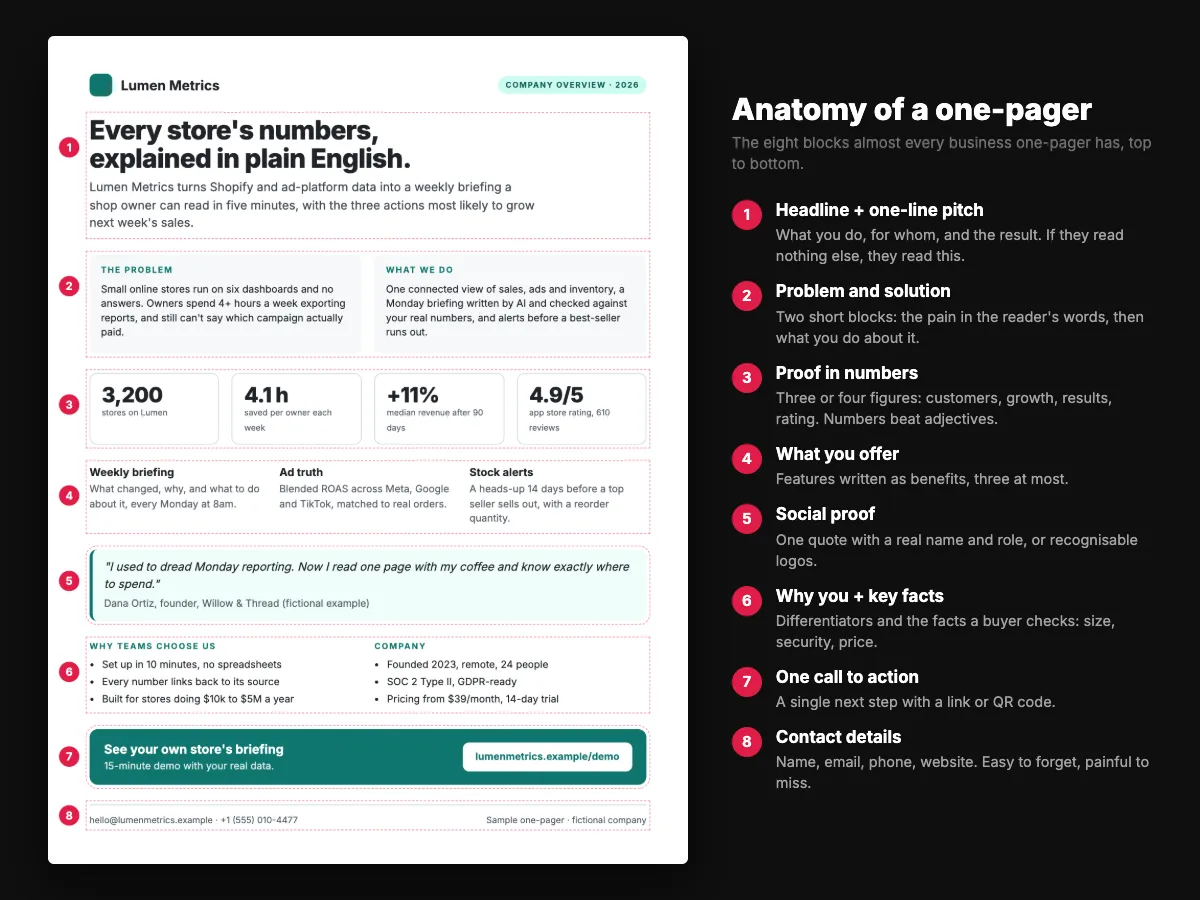
| Block | What goes in | Length |
|---|---|---|
| 1. Headline and pitch | The value, in plain words | 12 words, plus 1 or 2 sentences |
| 2. Problem | The reader's pain, with a number | 30 to 50 words |
| 3. Solution | What you do about it | 40 to 60 words |
| 4. Proof | Numbers with units and dates | 3 or 4 figures |
| 5. Offer | Features written as benefits | 3 bullets |
| 6. Social proof | A quote with a name and role, or logos | 1 quote |
| 7. Why you and key facts | Differentiators, size, security, price | 3 to 6 bullets |
| 8. Call to action and contact | One next step, the link or a QR code, email, phone | 1 line plus contact details |
What to include, by type of one-pager
| Type | Must include | Nice to have | Leave out |
|---|---|---|---|
| Sales | The pain, benefits, proof, a price or starting price, one call to action | A comparison with the alternative, a guarantee | Company history |
| Investor | Problem, solution, traction, market size, business model, team, the ask and use of funds | Competition, why now | Full financials, a detailed roadmap |
| Company overview | What you do, for whom, key numbers, locations, contact | Mission, values, client logos | Every product you sell |
| Product | The value, three benefits, a screenshot, the plan or price, call to action | Integrations, specs | The roadmap |
| Project brief | Goal, why now, scope in and out, timeline, budget, owner, the decision needed | Risks, success metrics | A task-level plan |
| Nonprofit | The need, impact numbers, one story, use of funds, ways to help, registration number | Goals, partners | Administrative detail |
| Event | What, when, where, who is speaking, price, how to register | Agenda, sponsors | Full speaker biographies |
| Student | Title and author, a central image, 2 to 4 quotes with page numbers, theme, analysis, a connection | A border quote, vocabulary, a symbol | Plot summary longer than three lines |
See each type finished in the one-pager examples.
Layouts that work
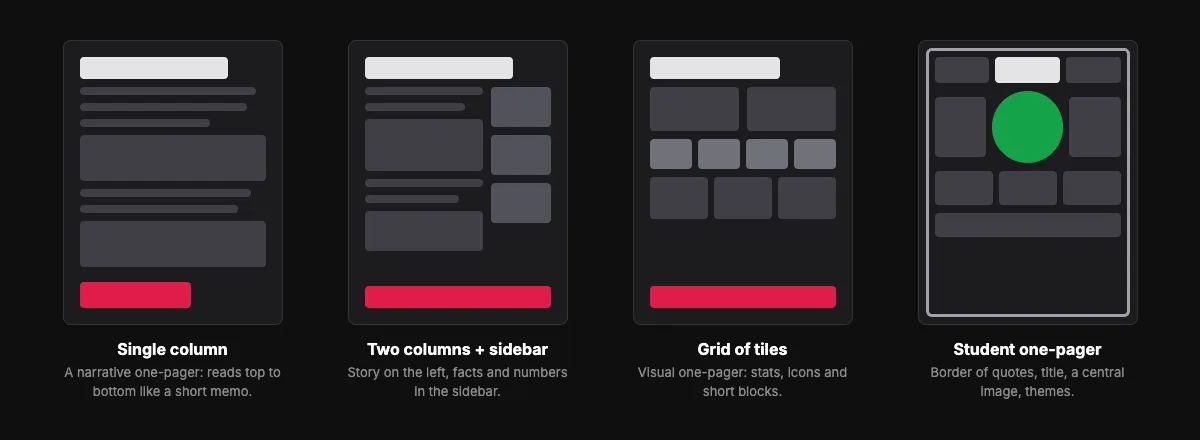
- Single column: blocks stacked top to bottom like a memo. Easiest to write; best for briefs and summaries.
- Two columns with a sidebar: the story in a wide column, numbers and facts in a narrow one. The default for company and investor one-pagers.
- Grid of tiles: equal blocks, big numbers, icons. Best for sell sheets and impact snapshots.
- Student layout: quotes in the corners or a border, the title on top, a central image and short responses around it.
Readers scan a visual page in a Z and a text-heavy page in an F. Put the headline at the top, the proof on the first line the eye crosses, and the call to action at the bottom right, where the scan ends.
One-pager size and dimensions
| Format | Page size | Pixels at 300 dpi | Best for |
|---|---|---|---|
| US Letter | 8.5 × 11 in | 2550 × 3300 px | Printing in the US and Canada |
| A4 | 210 × 297 mm | 2480 × 3508 px | Printing everywhere else |
| Screen PDF or image | Letter or A4 ratio | 1275 × 1650 px is enough | Email attachments, chat |
| Interactive (web page) | One responsive scroll | Fits any screen | Links, phones, video, updates after sending |
Keep margins of at least 0.5 in (12 mm). If a printer will trim the page edge to edge, add 0.125 in (3 mm) of bleed on every side. Type sizes that stay readable:
| Element | Screen | |
|---|---|---|
| Headline | 24 to 36 pt | 32 to 48 px |
| Block labels | 11 to 14 pt | 18 to 22 px |
| Body text | 10 to 12 pt | 16 to 18 px |
| Captions, footnotes | 8 to 9 pt | 13 to 14 px |
Two fonts at most: one for headings, one for text. A one-pager is one side; if you need the back of the sheet, you are writing a brochure.
File format: PDF, Word document or link?
| Format | Good for | Downside |
|---|---|---|
| Printing, email attachments, the exact layout everywhere | Hard to read on a phone; cannot be changed once sent | |
| Word or Google Doc | Drafts and internal briefs others will edit | Layout shifts between computers |
| Image (PNG or JPG) | Social posts, chat | Text cannot be selected or found by search |
| Web link (interactive) | Phones, video and charts, updates after sending, read tracking | Needs an internet connection; print needs a PDF export |
Many teams use two: a PDF for print and the meeting room, and a link for email and chat. An interactive one-pager can be both; the one-pager maker builds the web version.
What to leave out
- Anything the reader cannot act on now: the full roadmap, the org chart, the founding story.
- Every feature. Three benefits beat eleven features.
- Adjectives without proof: innovative, leading, world-class.
- More than one call to action.
- Paragraphs longer than four lines.
- Statistics you cannot source.
Format checklist
- All eight blocks, or a deliberate reason to drop one
- Blocks in reading order: value, problem, solution, proof, offer, social proof, why you, call to action
- One layout pattern, used consistently
- Letter or A4, margins of 0.5 in or more
- Headline 24 pt or larger, body text 10 pt or larger
- Two fonts, one accent color
- 250 to 500 words
- Saved as a PDF for print, or published as a link for screens
Start from a one-pager template


Frequently asked questions
What is the standard size of a one-pager?
US Letter (8.5 × 11 in) in the US and Canada, A4 (210 × 297 mm) everywhere else. At 300 dpi that is 2550 × 3300 px for Letter and 2480 × 3508 px for A4.
Is a one-pager front and back?
No, a one-pager is a single side. If the content needs both sides, it is a brochure or a two-page summary.
What is the best layout for a one-pager?
Two columns with a sidebar for most business one-pagers, a grid of tiles for visual sales and impact sheets, a single column for briefs, and the quote-border layout for student one-pagers.
Should a one-pager include pricing?
For sales one-pagers, yes, or at least a starting price: buyers trust a page that does not hide it. For investor and company one-pagers it is optional.
What font should I use for a one-pager?
A clean sans-serif such as Inter, Arial or Helvetica for body text, and either the same family in bold or one serif for headings. Two fonts at most.
What file format should a one-pager be?
PDF for printing and email attachments; a web link when most readers are on phones or you want to update it after sending.