What is a startup one-pager (investor one-pager)?
A startup one-pager (also called an investor one-pager or fundraising one-pager) is a single page a founder sends to an investor or an accelerator before a meeting. It covers the problem, the solution, traction, the market, the team and how much is being raised. Its job is narrow: get the investor to ask for the deck or offer a first call.
It is not a short pitch deck. A deck is built to be presented; the one-pager is built to be forwarded, so it has to make sense to a colleague of the investor who has never heard you explain it.
Two versions are in use. An investor one-pager leads with numbers and suits a company with revenue or users to show. A startup pitch one-pager leads with the insight (the idea, the market, why now) and suits a pre-seed company. Pick the one that puts your strongest evidence first.
When to use a startup one-pager, and when another format is better
Use it:
- In a cold email or a warm introduction, as the page the introducer forwards.
- In accelerator and angel-group applications that ask for a one-page summary.
- After a pitch event or a demo day, as the follow-up.
- For existing investors and advisors, so they can introduce you without rewriting your pitch.
Use something else when:
| Situation | Better format |
|---|---|
| The investor asks for more after reading it | A pitch deck of 10 to 20 slides, then the data room |
| You are selling to customers, not raising money | Sales one-pager |
| You are introducing the company to partners or press | Company one-pager |
| You are describing the product to users or buyers | Product one-pager |
| You are a charity raising donations or grants | Nonprofit one-pager |
| You need internal budget for an initiative | Project one-pager |
What to include in a startup one-pager
| Block | What it says | Target length |
|---|---|---|
| Header | Company name, a one-line description, the round and amount, the founders' email | 1 line each |
| Problem | Who has the problem and what it costs them, with one number | 30 to 40 words |
| Solution | What the product does and what changes for the user | 30 to 40 words |
| Traction | Revenue, growth, customers or retention, with dates, ideally as a small chart | 1 chart or 3 figures, plus 1 line |
| Market | TAM, SAM and SOM, with one line on how you calculated them | 3 figures |
| Business model | Who pays, how much, and the gross margin if you know it | About 20 words |
| Why now | The change that makes this possible or urgent today | About 20 words |
| Competition | The alternatives by name, and the one thing you do differently | About 20 words |
| Team | Two to four people, each with the one credential that matters for this company | 1 line each |
| The ask | Amount, runway, use of funds and the milestone it buys | About 30 words |
Total: 250 to 400 words plus one chart. Leave out full financial projections, the cap table and a detailed roadmap: they belong in the deck and the data room.
Investor one-pager example (free PDF)
Investor one-pager example
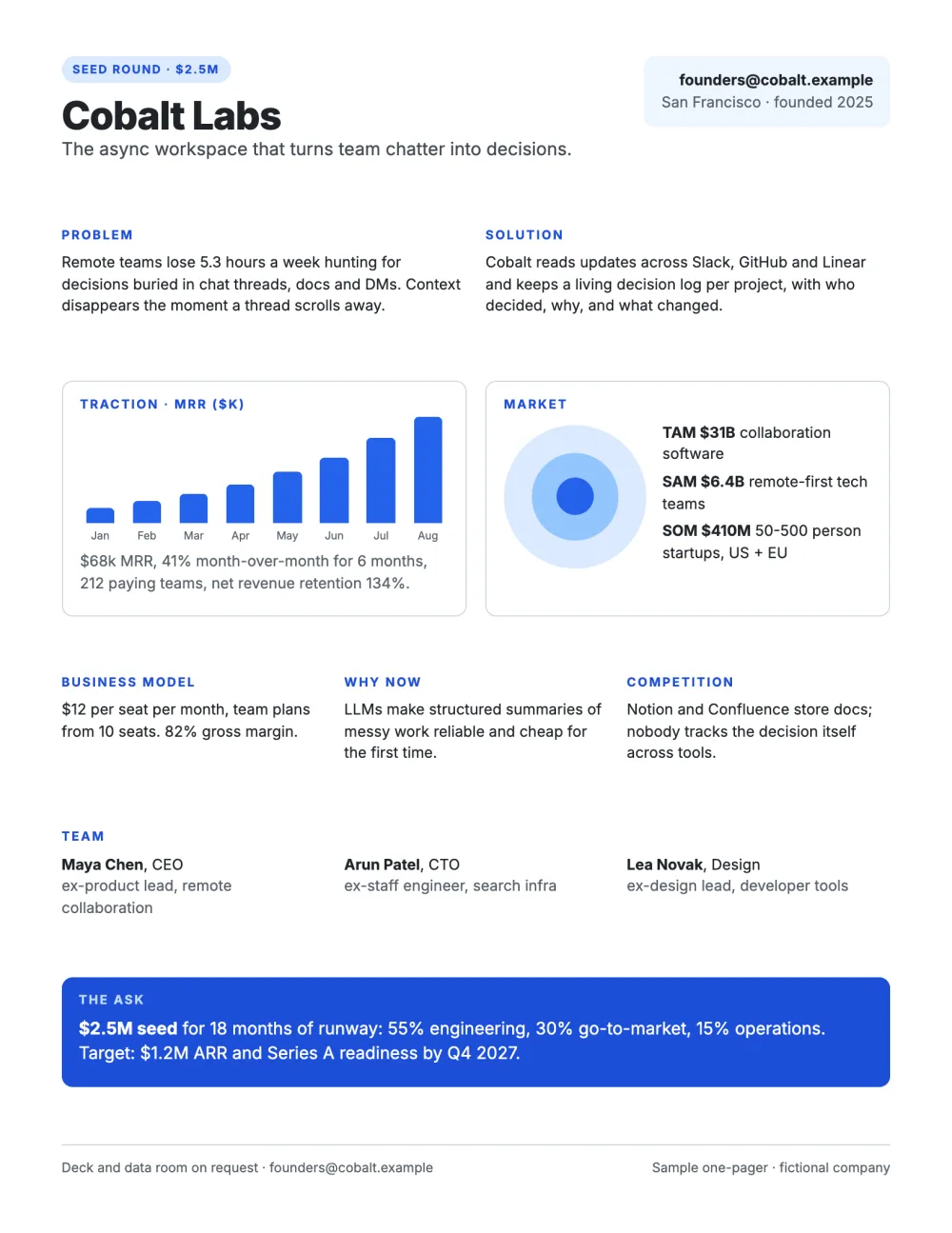
Our sample is for Cobalt Labs, a fictional seed-stage software company. The team, the figures and the round are invented. The round and amount sit in a tag above the company name. Below: problem and solution side by side, a traction chart with one line of figures, market size as TAM, SAM and SOM, then business model, why now and competition in three short columns, the team, and the ask in a full-width band. There is no blank version: use the example as your template and keep the block order.
What to copy
- The traction box shows a chart and repeats the figures in words, so it survives a black-and-white print.
- The ask adds up: amount, months of runway, three spending shares, one milestone.
Interactive startup and investor one-pager templates
Each template below is a web page, not a file: you edit it in the browser and share it as a link. Each image shows four moments of the scroll.
Investor one-pager template
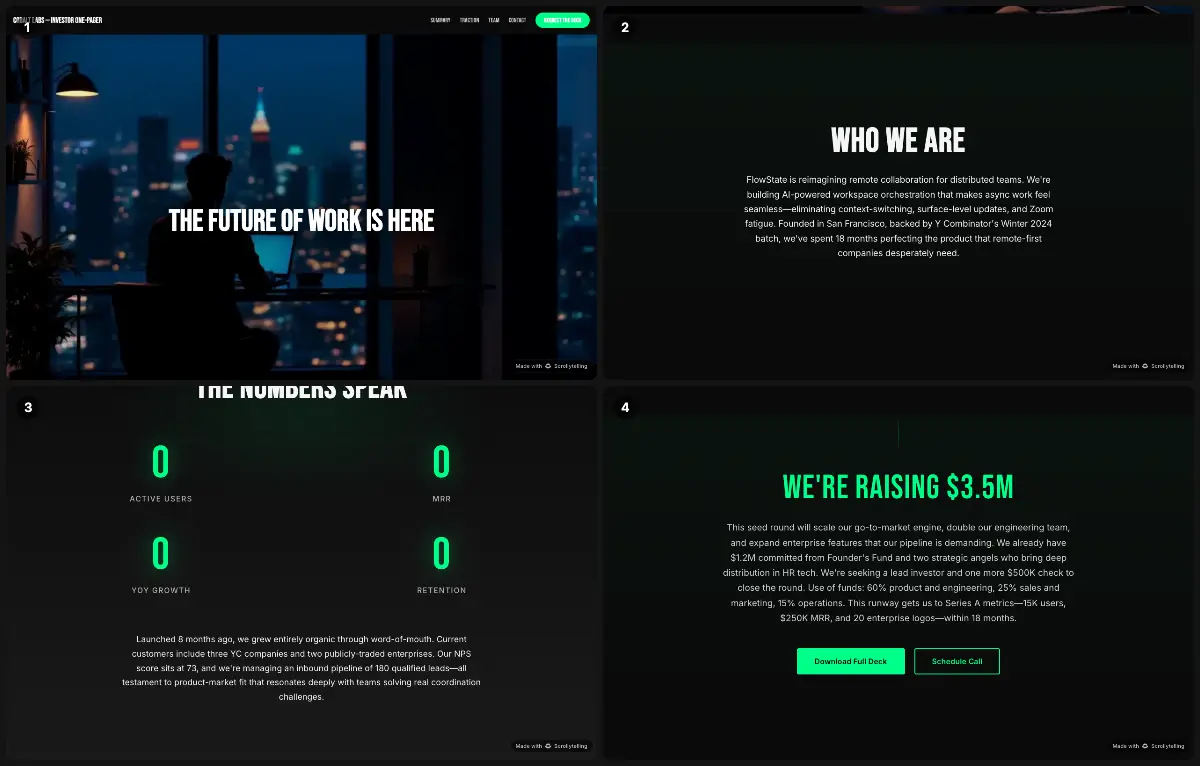
A numbers-led page for a seed round: a one-line hero, "Who we are", four counters for users, revenue, growth and retention, and a closing section headed with the amount being raised, the use of funds and two buttons (download the deck, schedule a call). The sample copy names investors and figures as placeholders: replace every one of them with your own before you send the page.
Startup pitch one-pager template
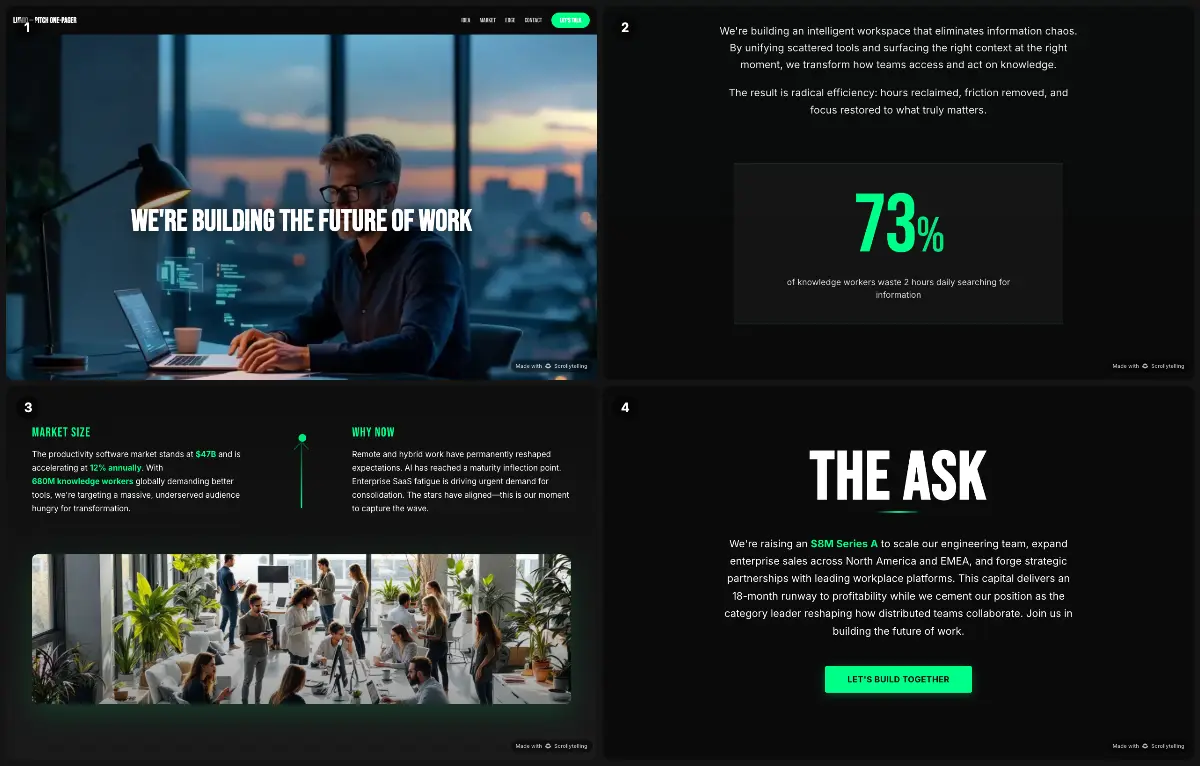
An insight-led page for a pre-seed or early round: the idea, one large statistic about the problem, market size next to "Why now", the team, and "The ask" as the last section. Use it when the story of the market matters more than your current revenue. The statistic and the market figures in the sample are placeholders, so source your own.
Worked example: the copy for an investor one-pager
The top and bottom of an investor one-pager for Fernway, a company we invented. Every name and number is made up.
Header
Fernway · Pre-seed · Raising $750k · founders@fernway.example
One line
Fridge monitoring for independent pharmacies, so a failed compressor never spoils a month of vaccines.
Problem
An independent pharmacy keeps its most expensive stock in one fridge and checks the temperature by hand twice a day. A failure overnight is found in the morning.
Traction
41 paying pharmacies and $9.8k monthly recurring revenue in October 2026, up from $2.1k in May. No customer has cancelled.
The ask
$750k for 18 months: 60% product, 40% sales. Milestone: 400 pharmacies and $90k monthly recurring revenue.
Every figure has a date or a unit, and the ask says what the money buys. An investor can repeat this page to a partner in two sentences.
7 startup one-pager mistakes to check
- No ask, or a vague one. State the amount, the runway it buys and the milestone at the end of it.
- Traction in adjectives. Give revenue, users or pilots with dates. If you have none yet, say so and lead with the insight and the team.
- One giant market number. A market in the billions with no SAM, SOM or method reads as copied. Show the three figures and one line on how you got them.
- Claiming no competition. There is always an alternative, even if it is a spreadsheet or doing nothing. Name it and say what you do differently.
- Resume-length team bios. One line per founder, with the single credential that matters for this company.
- Confidential detail on a forwardable page. Assume the page will be forwarded. Keep the cap table, customer contracts and detailed financials for the data room.
- Stale numbers. Put "data as of" and the month on the page, and update it before each round of outreach.
Printable or interactive: which one to send
Send a PDF when an accelerator form or a fund's intake asks for an upload, with the company name in the file name. Send a link in introduction emails that will be opened on a phone and forwarded: a web page reflows for a small screen, where a Letter-size PDF has to be pinched and zoomed. A link also lets you update traction every month without resending anything.
One caution: treat a published page as public, because anyone who has the address can open it. Keep anything confidential out of it, as you would with a PDF that will be forwarded.
Startup one-pager FAQ
How long should an investor one-pager be?
One side of US Letter or A4: about 250 to 400 words plus a traction chart. If you need a second page, the detail belongs in the pitch deck.
Is there a free startup one-pager template for Word?
Not as a .docx file from us. This page offers a free investor one-pager example as a PDF and two editable web templates that you change in the browser. To build the same layout in Word or Google Docs, use a two-column table with hidden borders, as described in the Google Docs and Word steps, and copy the blocks from the PDF.
What should a startup one-pager include?
The company name and a one-line description, the round and amount, the problem, the solution, traction with dates, market size (TAM, SAM, SOM), the business model, why now, competition, the team and the ask with the use of funds.
What is the difference between an investor one-pager and a pitch deck?
The one-pager is read alone in a minute or two and is meant to be forwarded; it earns the request for the deck. The pitch deck is 10 to 20 slides and carries the full argument, usually presented in a meeting.
What is a fundraising one-pager?
For a startup, it is the investor one-pager described here. For a charity, it is a one-page case for giving aimed at donors, which follows a different structure: see the nonprofit one-pager.
Draft your startup one-pager
Describe your company and your round in a sentence. The free one-pager maker writes and lays out a first version that you can edit, publish as a link or download as a PDF.
Open the free one-pager maker